-
 The Supreme Court on Monday rejected President Donald Trump's bid to restrict mail ballots for the midterm elections, capping a flurry of last-minute legal action with voting already underway. The decision allows states to continue sending out mail ballots under the same processes they’ve used for years and have accounted for nearly a third of votes cast. Alabama’s mail-in ballots for absentee voting were sent out last week.
 -
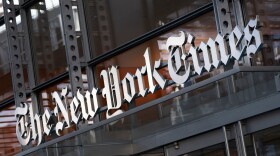 Former University of Alabama basketball player Kai Spears won his defamation lawsuit against the New York Times. Multiple published reports, including the Times, says a jury awarded the walk on athlete of over $9 million dollars following a trial in the aftermath of the murder of a Birmingham woman.
 -
 President Donald Trump didn't get what he wanted in some of the biggest Supreme Court cases this year. The list includes tariffs, birthright citizenship and the attempted firing of Federal Reserve governor Lisa Cook. But he also emerged from the term with even greater power. However, the 1964 decision in an Alabama legal case that helped define freedom of the press and defamation in the U.S. went unchallenged.
 -
 The fate of Alabama death row inmate Jeffrey Lee remains in limbo following actions by the U.S. Supreme Court and a federal judge in Montgomery. This situation appears to be spilling over to other states and the debate over capital punishment.
 -
 U.S. Rep. Barry Moore won the Republican runoff Tuesday for Alabama's open U.S. Senate seat, advancing to the fall election with the help of President Donald Trump’s endorsement. Moore defeated political newcomer and former Navy SEAL Jared Hudson. Races for AG, lieutenant governor, and U.S. House district 5.
 -
 Alabama on Friday asked permission to execute a man by lethal injection after court rulings blocked the use of nitrogen gas and cast doubt on the future of the state’s gas method. The Alabama Attorney General’s office filed a motion asking the Alabama Supreme Court to authorize a death warrant for Jeffery Lee, this time using lethal injection. The request came less than 24 hours after the state was thwarted in plans to use nitrogen to execute Lee, who was convicted of killing two people during a 1998 robbery.
 -
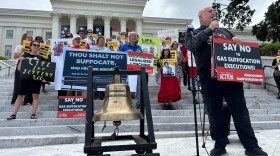 Less than one day after the U.S. Supreme Court refused to allow Alabama to use nitrogen gas to execute Jeffrey Lee for a 1998 double homicide, his legal team spoke out over Alabama’s former policy called “judicial override.” The loophole allowed the judge in Lee’s case to ignore his jury’s recommendation of life in prison and impose a death sentence. Alabama Public Radio focused on this controversial policy in its 2016 national award-winning investigation titled ‘…and justice for all.” Four months later, Governor Kay Ivey signed legislation ending “judicial override.”
 -
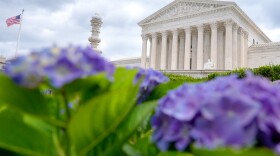 An Alabama man facing the death penalty by nitrogen gas was spared Thursday as the U.S. Supreme Court refused to set aside a lower-court ruling that found the method is unconstitutionally cruel, issuing a brief order that came well after the hour originally planned to initiate Jeffery Lee’s execution.
 -
 A no-holds-barred bout of partisan redistricting has been won by Republicans. Now it's up to voters to decide whether it matters for control of Congress. The previous map for Alabama had two Democrats, five Republicans. The U.S. Supreme Court in June allowed the state to use a congressional map approved by Republican state lawmakers that improves the GOP's chances of winning an additional seat by reshaping a Democratic-held district that has a large number of Black voters.
 -
 The Supreme Court allowed Alabama to use a congressional map favoring Republicans in this year’s elections, blocking a lower court ruling that the redistricting plan intentionally discriminates against Black people.

Digital Media Center
Bryant-Denny Stadium, Gate 4
Box 870370
920 Paul Bryant Drive
Tuscaloosa, AL 35487-0370
205-348-6644
© 2026 Alabama Public Radio
Bryant-Denny Stadium, Gate 4
Box 870370
920 Paul Bryant Drive
Tuscaloosa, AL 35487-0370
205-348-6644
© 2026 Alabama Public Radio
Play Live Radio
Next Up:
0:00
0:00
Available On Air Stations


