


Quick-Fire Quips is a questionnaire where we get to know people who stand out in the State of Alabama! In this episode, Alabama Public Radio host Baillee Majors talks with Brad Clasgens, volunteer archivist at SIGNALS Museum of Information Explosion in Huntsville— and musician on the side.
Baillee: Hey, Brad, how are you?
Brad: Hey, great to be with you today.
Baillee: So glad to have you on! For people who are unfamiliar, can you just tell me about the museum itself?
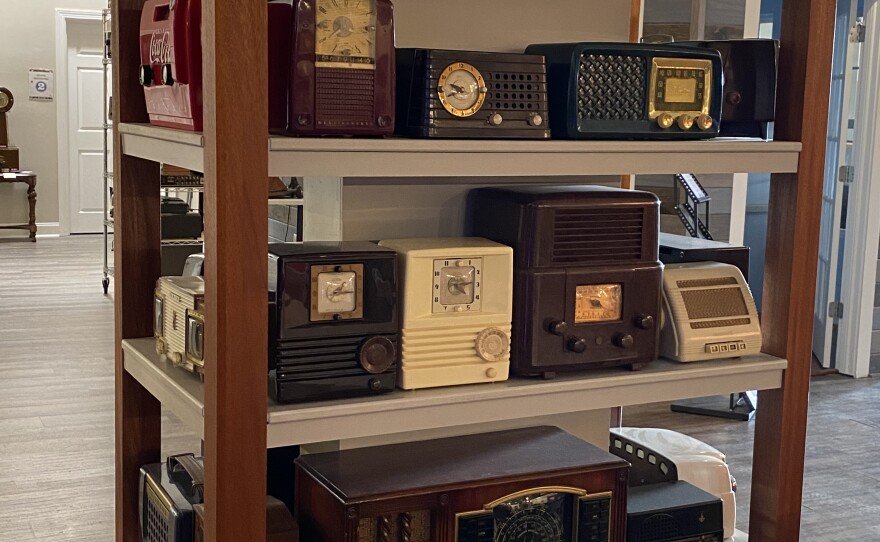
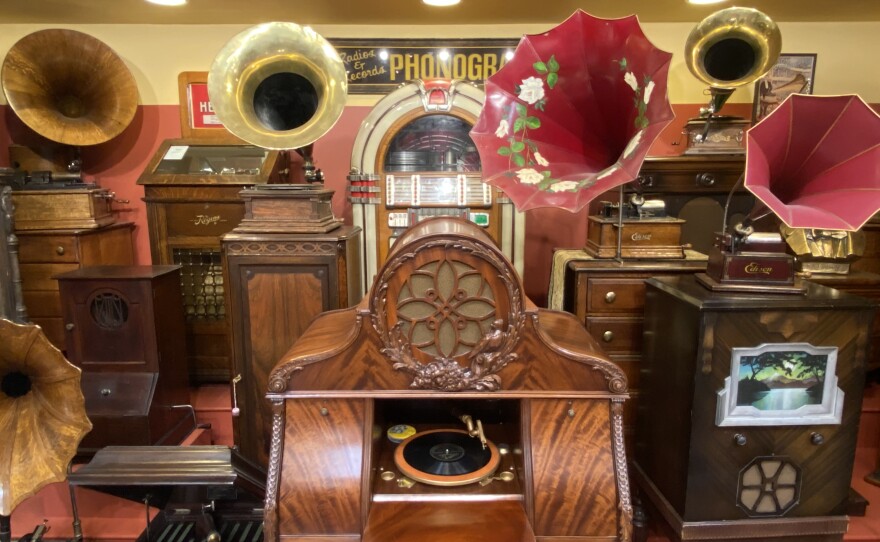
Brad: Signals started as a brainchild of Dr. Marc Bendickson. He has an extensive collection—really Smithsonian quality—of all kinds of communication devices, from telegraphs to batteries to telephones, radio, wireless radio, television and digital computers, all the way up to handheld information.
He basically has given this as a gift to the city. It's a private museum focusing on the history of communication over the past 200 years..
We're actually celebrating our one year anniversary on March 1st!
Baillee: Brad, tell me, what do you do at Signals?
Brad: I am a recording archivist. I’m a musician on the side, and I love old music
(Baillee and Brad laugh)
I’m the person who takes in all the donations—records, cylinders, tapes—any kind of recordings— research it to see what the history is on that and document it in a large database.
We've got close to 3,500 vintage recordings in our database already [and] another 1,500 that we're still processing. It is all types of recordings made, really since about the 1890s, all the way up to the current day. So, that's that's my job: to get to listen to all kinds of old recordings and figure out what to do with them.


Baillee: When you talk about recordings, are those conversations, music broadcast? What is included?
Brad: Any type of recording. It could be a commercial recording. It could be a recording where you went down to a drugstore and made a recording for somebody's birthday back in the '30s.


Baillee: Oh, wow!
Brad: It could be a transcription record where—that say the US Army put out and sent to radio stations with 30 minutes of music and 10 recruiting commercials on it. It could be just popular music, everything from W.C. Handy all the way up to Post Malone.
Baillee: I love that!
Brad: It's just any type of recording, and it could also be from dictation machines. We've got early Edison dictation machines from the 1920s, for example. So if it's a recording, we have a way to play it there.
Baillee: Well, now that introductions are done, let's go ahead and get you warmed up to answer the questionnaire. And to do that, I want you to say "Quick-Fire Quips" three times fast.
Brad: Quick-Fire Quips, Quick-Fire Quips, Quick-Fire Quips.
Baillee: Very nice. Did you practice?
Brad: I did.
Baillee: Okay, well, it paid off!
(Baillee and Brad laugh)
Here's the first question: What comes to mind when you hear Alabama?
Brad: Personally, I grew up in Memphis. I married a woman from Huntsville, and I think of Alabama now as my home, and what a great city Huntsville is to raise a family. We love it here.
Baillee: What is a hidden gem in Huntsville that more people should know about?
Brad: Up on top of Green Mountain. It's actually just a nature trail up there. It's a public park, and it's a lake that's up on top of the mountain. It's just a beautiful place to escape to nature.
It's got a little covered bridge on it; it's just a quiet place, a nice place for a picnic. We take the kids up there fairly often.

Baillee: What is a bad stereotype or something that people get wrong about Alabama?
Brad: That people are barefoot and, you know, wearing shorts and have missing teeth and things like that. Especially here in North Alabama, it's a very, very smart, cosmopolitan city.
Baillee: What is something that you wish more people knew about when it comes to information sharing and technology?
Brad: It's harder and harder to find trusted sources of valuable information, whether that is opinion, politics, government meetings, or just what's happening on the football field.

Public radio is a great place to start. NPR, PBS—they're just still good, solid, reliable sources. I think people need to make that a part of their day, to be totally informed on what's going on in our world.
Baillee: So, you shared what you do as a recording archivist. Can you talk about why archiving is so important?
Brad: For the purposes of the museum, it's mainly because if we have a 1935 phonograph of some sort, I want to quickly be able to find some of our 1935 records to play on it.
But more importantly, we've got to make sure that we are archiving this information; a lot of this is disappearing. We rely on a wonderful database from the University of California, Santa Barbara, that has over 350,000 recordings in their archive. And so we look and see what information we can find out there.
![Naval training station [Newport, R.I.] learning wireless telegraphers](https://npr.brightspotcdn.com/dims4/default/0e16fcb/2147483647/strip/true/crop/1024x743+0+0/resize/840x610!/format/webp/quality/90/?url=http%3A%2F%2Fnpr-brightspot.s3.amazonaws.com%2Fe2%2Ffe%2F4e6a352d4b7d8f7b9b0a431afba5%2Fnaval-training-station-newport-ri-learning-wireless-telegraphers.jpg)
Baillee: A lot of people use calling, texting or voice memos, but can you talk about some past methods of communication that some people might not think about?
Brad: We forget how much the telegraph played—what an important role it played— in the Industrial Revolution back in the 1800s. From keeping the trains on schedule to military communications and things like that.

Morse code was around for many, many years. We're working on a display to look at semaphore—the use of flags in the military as well. There's lots of different ways to communicate.
It's funny, when we take kids through the telephone exhibit: the first thing they don't understand is what to do with the handset that you put in their hands.
They just kind of get an empty look, and they say, "What do you mean?" And we have to teach them how to dial a phone. That doesn't seem that strange to us, but for somebody who's 10 or 15 years old, this is a whole new world for them!
(Brad and Baillee laugh)
Baillee: Are there any kind of main attractions in the museum... What can people expect to see?
Brad: The collection of of devices is absolutely stunning, but it's a very hands on museum. You and a friend can sit down at the Morse Code Exhibit and actually practice. It's a form of Guitar Hero that you can see who can transmit a message via Morse code faster than the other. It's a lot of fun for people!
There's a working 1920s phone switchboard from a hotel and a map of Huntsville. It shows you how telephones were connected years ago, from a farm out on the country to a drugstore or to the hospital or to the school or that type of thing.
Lots and lots of hands on things, especially in the early days of electricity: Spark machines and and things that make your hair stand on end and stuff like that. It's a whole history of fun and unusual devices.

Baillee: Besides things like emails and cell phones, are there any other modern communication methods that people may not think about that are available?
Brad: It's interesting to look at the different formats that recordings have gone through in recent years. This past year, there were more vinyl records sold than in the last couple of decades. You're seeing a resurgence in CDs, and believe it or not, in cassettes.

There are musicians putting their work out on different types of machines. And it's because today's youth, who grew up with everything on a device, want the actual physical—they want to have the physical piece of property that has that on there.
So even things like Sony Walkmans are coming back, and used cassette sales are very, very strong right now for the same reason. So it has to do with: Do I own stuff on a cloud, or do I own stuff right here in my hands?
Baillee: I do really like the shift from digital back to a little bit more of a physical media standpoint.
Brad: Vinyl is the very best way to play back music. There's all kinds of cool digital things, but to feel that warmth coming out of the sound there—I'm glad it's back.
Baillee: So before Signals, you worked at WHNT 19. Can you speak [about] why communication and information technology is important?
Brad: I worked at WHNT; had 23 wonderful years there. Worked primarily in sales, but also worked in the ad agency business and for Gannett newspapers and done some radio. So, it's been all across the communication spectrum, as well as retail advertising.
But a couple of weeks ago, my cell phone carrier went out, and all of a sudden I realized I couldn't tell my wife where I was. We were going to check in later and decide what to do about dinner and such, and all of a sudden I had no way to reach her. And that went on for close to almost 24 hours.
We have become so dependent on these devices that all of a sudden, when they're not there, you really realize how much you used to take them for granted. And of course, I grew up in a time when I would tell my mom I'd be home by sunset, and that was pretty much all there was to it.
So, it goes back to the whole story of: How do you find good sources of information? How do you make sure that those sources are robust, whether it be severe weather warnings or what time a football game is at a certain stadium? It's one of those things that we've got to preserve and protect.


Baillee: So, tell me: do you have any superstitions or rational fears?
Brad: I don't do heights well.
Baillee: I think that's rational.
(Baillee and Brad laugh)
Brad: Working in the TV business, seeing videos of those guys that climb the towers for a living and change the light bulb at the top... holy cow, my hands get sweaty just thinking about it!

Baillee: Yeah, not for me either. I'm right there with you. All right, Brad, tell me something on your bucket list.

Brad: One of the things I'd like to see personally, just as a musician, is the Musical Instrument Museum in Phoenix, Arizona. It's got a history of all kinds of musical instruments. I'm a percussionist, but I'm really into all kinds of old gear. I really do enjoy that.
Baillee: Are there any percussionists, past or present, that you think are just very, very impressive?
Brad: I'll throw Hal Blaine out. He's one of my favorite drummers, and he's one of those people who has played on more gold records than any other percussionist out there.
He played in the Hollywood studios out there, and he is on everything from Henry Mancini to the Monkees to the Beach Boys, you name it.
Baillee: Who was your childhood hero?
Brad: Growing up in the '70s, it was Neil Armstrong. And really all the Apollo astronauts.
Michael Collins—who was the command module pilot back then and was the one who let Buzz and Neil go to the moon—to read what his orders were if that rocket didn't take off and what he had to do to fly back without them, what his orders were— absolutely freaking scary!
We kind of gloss over, "Wow, they went to the moon," but how many ways those astronauts were in danger every single minute of those missions?
Still heroes to this day.


Baillee: Here's our last question. What does Alabama need?
Brad: We need to listen to the dreams of our children. We need term limits for all politicians, not just in Alabama.
I feel good about the history, about the future of our country, as we're going to see this young generation of my kids and younger fix all the world's problems.
It's in need of great change again, and I know my kids and their generation will get this all worked out.
Baillee: That's it for today's Quick-Fire Quips, a speedy questionnaire where we get to know people who stand out in the state of Alabama. That was Brad Clasgens, volunteer archivist at SIGNALS Museum of Information Explosion in Huntsville. I'm your host, Baillee Majors. Find us at APR.org for more Quick-Fire Quips.
Keep up with Signals:
— Website
— Facebook
— Instagram
— TikTok
— LinkedIn
— Donations and support
