


Quick-Fire Quips is a questionnaire where we get to know people who stand out in the State of Alabama! In this episode, Alabama Public Radio host Baillee Majors talks with Jun Ebersole, a paleontologist and Director of Collections at McWane Science Center in Birmingham.


Baillee: Hi, how's it going?
Jun: Hi, Baillee. Thanks for having me.
Baillee: Absolutely! Okay, so before we get started, let's get some basics out of the way. For those who are unfamiliar, explain what a paleontologist does.
Jun: We look at the fossil record. People often mistake archaeology and paleontology, but it's kind of the difference between being a vet and being a doctor. Your vets being your paleontologists dealing with animals in the fossil record, archaeologists dealing with humans.
Baillee: That's a good explanation. What's the coolest thing that you do as a paleontologist?
Jun: I get to work here in Alabama. People don't realize that we're the number one state in the U.S. for fossils. People think you have to go out West to find fossils. When it comes to fossil diversity—different species of fossils—we are by far number one, and I'm one of the few people in the state essentially studying the entire history of life in one place.
Baillee: Yeah, not to brag or anything. Very humble about it.
Jun: It's so strange that, you know, the rest of the world is starting to understand this, but Alabamians are still way behind in understanding how remarkable we are here.

Baillee: What you do at the McWane Center.
Jun: I am the Director of Collections, so I oversee the second-largest natural history collection in the state. The majority of our collection—85% or more—is fossils. We have small archaeological collections, geological collections, dead animal collections—we have a lot of those—but fossils, fossils from Alabama.
Baillee: What is the coolest fossil, in your opinion... at the McWane Center?
Jun: Oh gosh, you know, we just did hang a 63-foot, gigantic fossil whale called Basilosaurus [cetoides]. It's the state fossil of Alabama.
Baillee: I have read about that.
Jun: You come off our elevators and it's the first thing you see. Very cool. It's one of my favorite specimens, really, to show off, not only because it's just gigantic, but the history of it is just so fascinating.
When these things were really discovered in the early 1800s, people didn't know what this animal was, and it really put Alabama in—globally, the scientific world was looking at Alabama trying to figure out what this was. People thought it was the sea monster from the Book of Job, some thought it was a dinosaur, but it turned out to be a 37-million-year-old fossil whale.
So it really put Alabama in the spotlight, really bringing to light the immense fossil record that we have here that has since been forgotten. But now over the past 15 to 20 years, Alabama's back in the spotlight again. So it's really coming full circle.

Baillee: We're going to talk more about paleontology and fossils and the McWane Center and all that good stuff. But are there any social media handles that you can throw out, either for you or the McWane Center or websites?


Jun: Yes, definitely get on our website, McWane.org, and yeah, we are on everything from Facebook and Instagram. We have our own [YouTube] channels where we do science programming and such.
There's also links to the work that I do, so you can see the scientific publications and learn about the specimens in our collection. I launched a new website called [Fossil] Fishes of Alabama. That's the world's largest resource on basically fossil shark and bony fish identification.
Because we're the number one state in the U.S. for fossil sharks. So here's a resource for everybody to look up the stuff they're finding in their own backyards.
Baillee: Well, now that the introductions are done, let's get you warmed up to answer the questionnaire. And to do that, I want you to say "Quick-Fire Quips" three times fast.
Jun: Quick-Fire Quips. Quick-Fire Quips. Quick-Fire Quips.
Baillee: Here's the first question: What comes to mind when you hear "Alabama"?
Jun: To me, it's biodiversity. That's always the first word. People don't realize that if we're not number one, we are going to be number two or number three in biodiversity—recent plants and animals. But then also in the fossil record, we're number one in paleo-biodiversity—different species of fossils.
Baillee: That's awesome. Okay, what is a hidden gem in the Birmingham area that more people should know about?
Jun: McWane Science Center, where I work. If you've never been, we're a hybrid facility. We are the largest museum in the state, but we're not a traditional science center where we combine various elements that are generally standalone.
We have an aquarium, we have a natural history museum, we have a children's museum for ages six and younger, and then we have the science center and the IMAX theater all in one building, really trying to bring all these various elements to our community.


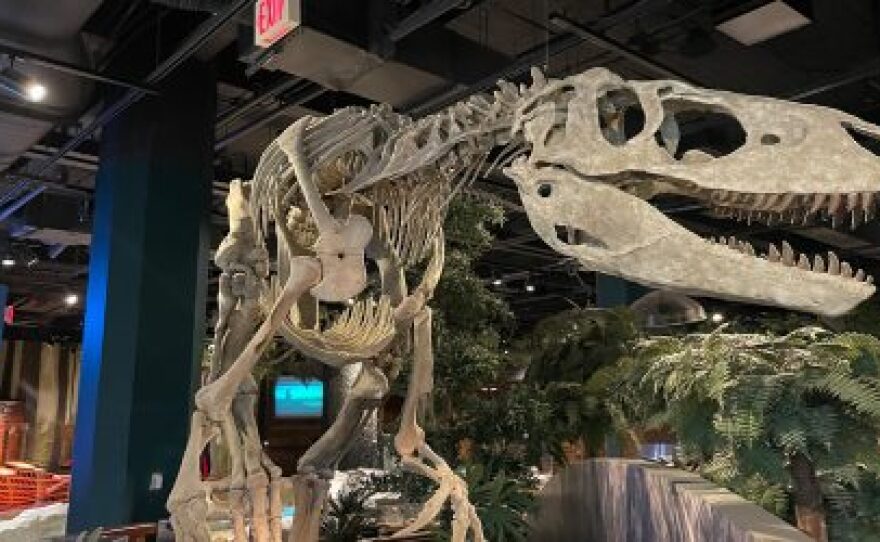


Baillee: There are hands-on exhibits too. It's not just "look," right? There's interactive things.
Jun: That's what we try to do. So even though we do have natural history exhibits, we try to present them in a science center manner—being very, very hands-on and engaging with educational programs, with our educators out on the floor helping to explain the process of science, as opposed to what natural history museums normally do, which is the products of science.

"Here's a specimen on display and everything that some curator knows about it." We want to help people connect those dots on how did we come up with the stuff on that signage? What is the process? How did we figure out what this dinosaur ate, or how old it is, or how fast it ran? Working through the science of it.
Baillee: What is your favorite thing about living in Alabama?

Jun: Oh, the natural wonders in the state, by far... Mountains in the north, prairie lands in the center, to gorgeous beaches in the south. It's really amazing.
Baillee: Here's your next question: what is a bad stereotype or something that people get wrong about Alabama?
Jun: Coming from outside of the state, there is this stigma that Alabama is just full of ignorant people and so forth. Racism is something that comes up. If you're outside of Alabama, you don't understand what Alabama has. Especially, you know, from what I study, it's the natural world.
But it's also interesting that people in Alabama also take it for granted. You know, we have so much of this gorgeous landscape here, an unbelievable amount of fossils and Native American material and such. Everybody here grew up with it; they take it for granted. They can go out in the creek and find sharks' teeth and such. Elsewhere, you don't get that opportunity.

Baillee: I feel like that is actually really common—to find fossils in riverbeds.
Jun: Oh, 100%. Like I said, we are the shark tooth capital of the world. And to kind of put that into perspective, oh, about six or seven years ago, the University of Florida came out with a big press release. They'd written a paper looking at 100,000 teeth that they had in the University of Florida collection, and they found 70 species of sharks—which sounds like a lot.

Baillee: Yeah, sure.
Jun: Sharks is what I specialize in. My number is over 400. So if they declared themselves the shark tooth capital of the world, what does that make Alabama? Shark tooth capital of the cosmos, I guess.
Especially when you're on the Coastal Plain, Montgomery on south. You're—it's essentially the past 100 million years of the shorelines of the Gulf of Mexico. So you have 100 million years worth of beaches. For every mile you go south, you're going one million years forward in time, essentially the entire last 100 million years of oceans in one place.
North of Montgomery, it's stuff that goes back 500 million years. Most people finding sharks' teeth in the creek are going to be in the southern part of the state, and every creek and stream you walk, you have a chance to find them. It's remarkable.

Baillee: So what is the interest in sharks... what drew you to that?
Jun: Yeah, it's interesting. My academic background is in fossil humans. I was working in Africa, and when I came back to the States, I was doing archaeology in the Northeast. Well, McWane Science Center, back in the late '90s, was hiring for their collections department.
They had archaeological material, but then they also had a huge fossil collection, so they were looking for somebody with a background in both. But they are very different fields of study.
Archaeologists have a completely different degree than paleontologists doing what's called paleoanthropology—it's where archaeology and paleontology crossover.

I had no idea I'd end up studying sharks, but just going through and doing basic cataloging of the collection, just having to identify stuff to a certain level so I can put it in a database and track these things for insurance purposes, legal purposes, or research purposes—we just had tens of thousands of sharks' teeth.

We just have so much here. Rather than reading other people's publications... I started publishing on those. So that really was my foray into sharks specifically, which I probably have the deepest knowledge on. But I study vertebrates in general. If it's got teeth, I'm interested in it.
Baillee: So what's so cool about fossils—what's the appeal? What's the story there?
Jun: What's unique about Alabama is we have the most complete geologic column in the U.S. Meaning, if you take all the levels of all the layers of rock from the beginning of life until now over the past 500 million years, and you stack them up like a stack of books, we have more of those books than any other state.
So it literally is the history of life in one place. There are authoritative textbooks out there which will talk about the history of life, but they've got to travel around to different countries all over the world to look at their fossil evidence to piece it together. We can do it just by driving up and down I-65.
Baillee: You talked about sharks, sharks' teeth, bony fish, the fisheries. But you also have some experience with dinosaurs or a specific dinosaur.
Jun: Eotrachodon! So Alabama is actually the best state in the eastern half of the country to find dinosaurs, but they are exceptionally rare... finding a dinosaur in Alabama is like swimming at the Great Barrier Reef and coming across a cow. Unbelievably uncommon.
There are certain pockets of places that are kind of dinosaur-heavy here. Normally we'll get like a single broken bone or a single tooth, but there are certain times where we can find partial skeletons. Every partial skeleton that's ever been found in Alabama—which is about every single one—has turned out to be a new species.
So I was lucky enough back in 2016 to work with a couple of colleagues to name the most complete dinosaur ever found in the eastern half of the country, found right outside the city limits of Montgomery.

It was a duck-billed dinosaur, but it was so different we got to name both the genus and the species. So the genus name is Eotrachodon. Orientalis is the species name. It essentially means "dawn rough tooth from the east."
So it's what we call "basal" duck-billed dinosaur. Meaning, it strongly suggests that duck-billed dinosaurs from around the world—and if there's any places out there that have Cretaceous dinosaurs, that's just about every continent out there, you're going to have some sort of duck-billed dinosaur.
It appears that ours is so basal, so it has these very primitive characteristics, that it's very possible that all duck-billed dinosaurs around the world originated here in the Southeastern U.S.
Baillee: Would you say the dinosaur fossil was one of the coolest that you've been able to learn about or work with?
Jun: I don't necessarily specialize in dinosaurs, so to be able to collaborate, you know, with good friends who are the world's authority in this thing, that's always fun. But the uniqueness of it—you know, how many people have ever named a dinosaur? There's only a, for real, finite number of them. But it turns out I'm the only Alabamian ever to name a dinosaur!

Baillee: That should be in your "Two Truths and a Lie." That's so cool! So tell me, What kind of effort goes into fossil preservation?
Jun: Well, the preservation side—there’s a lot that goes into it. A lot of what I do is called bulk sampling, where I’m going into streams, rivers and caves and bringing back giant bags and buckets of dirt. It just takes hours and hours and hours to basically go tablespoon at a time, taking this dirt, putting it under the microscope, and pulling out the small fossils.
The true diversity of what makes this number one is the small stuff... recording all this data is a huge part of it. Without its scientific data, it’s essentially just worthless. The most important thing I can do is to publish on it. Unless it’s published in a peer-reviewed journal, it’s not fact.
Rather than talk to every single person about their favorite dinosaurs, I can write one scientific paper and educate the world. It’s not just teaching the people living today, but everybody else to come... to pull that focus to Alabama. It’s really the most important thing I can do.

Baillee: What’s your favorite part of your job?
Jun: Every day I come in, it’s something different. I just finished digging up a fossil sperm whale—not a fossil, actually, a recent sperm whale. It’s the only whale ever to die in Alabama waters.
Going to dig up this gigantic, 35-foot whale was interesting. I had to dig out about 100 pounds of brain matter. Never thought I’d ever do that in my career.

This job just allows me to preserve Alabama’s history. It’s always challenging physically and mentally, but then the science behind it is just so, so fascinating.
Baillee: Yeah, sometimes you're in the lab and sometimes you're elbow-deep in brain matter.
Jun: Correct. But then just a few weeks later, we hang this 63-foot fossil whale from our lobby!
Baillee: Is Alabama lacking in paleontologists?

Jun: Oh, very much so. Across the U.S., there’s probably less than 150 actually true professional vertebrate paleontology positions... You have a six times better chance to make a Major League Baseball team than you do becoming a professional vertebrate paleontologist.
Baillee: If someone’s interested in fossils, where’s a place to get started?
Jun: Just go outside. Go find what you can find. If you live in the Birmingham area, there is the Alabama Paleontological Society, amateur fossil hunters, but they’re unbelievably knowledgeable... There are certain fossil hotspots on the beaches that people don’t seem to realize are just right under your feet.
Baillee: I feel like I could pick your brain for hours on that kind of stuff. Let's move on to some of the [other] questions for Quick-Fire Quips. Do you have any superstitions or irrational fears?
Jun: Oh my gosh! Superstitions? I’m a big sports fan, so I’ve got many.
Baillee: Let's hear them.
Jun: Well, if my team—the game is close, I can't sit down anymore. I’m standing up. The closer the game is, the closer I am to my TV. If the game is close and all of a sudden they’re losing, I can't watch anymore. I've got to leave the room. But then when I come back in, they just happen to be taking the lead again! I don’t know why.
Baillee: Yeah, there’s evidence that it works!
Jun: Yeah, it obviously has to do with me.

Baillee: Clearly, yes, of course! Okay, tell me something on your bucket list.
Jun: Originally having an archaeology background, obviously there’s places around the world that I have to go and see before I can’t—places like the classics. I’ve got to go to Italy, I’ve got to go to Pompeii, got to go to Greece. Getting back out to Africa, you know, really where my career had gotten started.

But I have a huge, huge bucket list for my research here, my work here in Alabama. Yeah, certain things that I’ve been working on for decades that I’m not going to stop until I get those things, like, crossed off my list.
Baillee: Did you have a childhood hero?
Jun: Growing up in Chicago, it was obviously Michael Jordan... Growing up in Chicago during the Bulls' title run, it gave me a lot of respect, where I was able to recognize what was happening here during the Saban years.
So coming here, you know, not being a huge fan of Alabama football when I first moved here, it’s like, "Oh, wow." But I recognize what’s going on. And so, yeah, to be able to experience that a second time in a lifetime is amazing.
Baillee: So is he still your hero today?
Jun: Oh my gosh, very much so. If he comes on TV, it’s like, "Oh, I've gotta stop and watch this."
Baillee: What is your favorite getaway spot in Alabama?
Jun: As much as I love Gulf Shores, the restaurants and stuff—Dauphin Island. It is just a hidden gem down there, and it’s just more quiet and laid back. I go down there for the research component, going to the Dauphin Island Sea Lab.
Just the number of friends I have down there—where they’re just down there because they love it. And so we’re all just big nerds just going down there and we’re out there fishing. There’s nothing better.

Baillee: Okay, this is our last question. What does Alabama need?
Jun: Alabama needs more recognition. I love the motto of Alabama: "Alabama the Beautiful." I think Alabamians just need to buy more into that. We need to protect this stuff while we still have it, or we’re going to regret it when it’s not there anymore.
Baillee: That’s it for today’s Quick-Fire Quips. A questionnaire where we get to know people who stand out in the state of Alabama. That was Jun Ebersole, a paleontologist and Director of Collections at McWane Science Center in Birmingham. I’m your host, Baillee Majors.
Click here for more Quick-Fire Quips!
